
Module 4: Dating Violence/Intimate Partner Violence

📖 Chapter Overview
Overview
Welcome to this module on Dating and Intimate Partner Violence. This module explores dating and intimate partner violence (IPV) with a focus on equipping you with the knowledge and tools to identify, prevent, and respond to various forms of abuse in relationships. It addresses not only physical violence but also less visible forms such as emotional manipulation, coercive control, and economic abuse. Through evidence-based content, interactive activities, and real-life scenarios, the module promotes critical reflection on gender norms, power dynamics, and common myths that can conceal harmful behaviour. The module also emphasises the importance of inclusivity by examining how IPV affects individuals across different genders, sexual orientations, and social backgrounds. By the end of the module, learners will be better prepared to recognise red flags, understand what healthy relationships look like, and contribute to a culture of safety, respect, and support in their communities.
Chapter’s Learning Objectives
Chapter’s Learning Objectives By the end of this module, you will be able to:
💔 What is dating and intimate partner violence?
Key Topics
The World Health Organization defines intimate partner violence (IPV) as behaviour within an intimate relationship (including both current and former partners) that causes physical, sexual, or psychological harm. This includes acts of physical aggression, sexual coercion, psychological abuse, and controlling behaviours (WHO, 2022). Furthermore, the European Institute of Gender Equality (EIGE) also defines economic violence as a form of IPV, and emphasises that IPV constitutes a form of violence which affects women disproportionately (Council of Europe, 2011).
Looking across all types of relationships, around 1 in 3 women will experience some form of IPV in their lifetime, whether physical, sexual, or emotional (McCauley et al., 2023). Male intimate partners or ex-partners are the most common perpetrators of violence against women (WHO, 2012).
Women who have suffered IPV in relationships with men, often described the violence as rooted in hegemonic masculinity (McCauley et al., 2023). Hegemonic masculinity is a cultural idea that being a “real man” means being dominant, unemotional, and in control. Connell and Messerschmidt (2005), explain how this societal pattern -where stereotypically male traits are idealised as the masculine norm—may help explain why men maintain a dominant social role, while women and other groups perceived as feminine hold a more subordinate role. Such beliefs can make aggressive, possessive, or controlling behaviours seem normal or even desirable.
Many women report experiencing men exerting control over their bodies and sexualities (McCauley et al., 2023). When men perpetrate emotional abuse, they often intend to humiliate their partners and exploit heteronormative social norms (McCauley et al., 2023). These forms of violence can vary widely—from psychological to sexual abuse. In many cases, men view themselves as the provider and/or more powerful than the victim.
Hegemonic masculinity can also pressure boys and men to display strength, control, and heterosexual dominance (Connell & Messerschmidt, 2005). Other forms of masculinity, especially those viewed as feminine, are either marginalised or subordinated to the hegemonic version, which symbolises and enacts power over both women and other masculine identities (Kwak, Taber, & Stults, 2024). Because society often expects men to be “tough” and self-reliant, even those considered hegemonically masculine may feel shame about speaking up, or struggle to recognise or admit that they are experiencing abuse (Kwak, Taber, & Stults, 2024).
While women are disproportionately affected, IPV occurs in all kinds of relationships and may look different from one to another. However, many warning signs are rooted in power and control. In LGBTIQA+ relationships, especially among young sexual minority men (YSMM), abuse may be shaped by social expectations around masculinity. Studies have found that some partners may use violence or emotional manipulation to “prove” their masculinity, avoid appearing weak, or control their partner’s identity expression (Kwak, Taber, & Stults, 2024). Conversely, because women are not typically expected to be violent, it can be harder to recognise violence when they are the perpetrators, due to the construct of femininity.
Men and non-binary people also suffer from GBV.
ANSWER: TRUE
Intimate partner violence (IPV) is the most common form of gender-based violence and is reported to occur in all countries, cultures, and levels of society (Garcia-Moreno et al., 2006). IPV can affect people of all genders and occurs in all types of relationships— not just women in heterosexual relationships.
While some of the data presented below are drawn from studies conducted in the United States, gender-based violence (GBV) is an equally serious and widespread issue across Europe. For more detailed information on the types and prevalence of GBV in your country, you can consult the EU “Gender-Based Violence Survey” (hyperlink: https://ec.europa.eu/eurostat/web/gender-based-violence) (2023), conducted by Eurostat in collaboration with all 27 EU Member States. The survey provides official, comparable data on physical, sexual, psychological, and economic violence experienced by women across Europe.
The National Intimate Partner and Sexual Violence Survey (NISVS) estimated that 30.9% of men in the United States have experienced IPV during their lifetime (Smith et al., 2017). According to the National Statistics Institute of Spain (2023), the data reveal that in Spain the 2023 survey reported 9,126 victims, 12.0% more than in the previous year. Among them, 61.1% were women, and 38.9% were men. Research also shows that women belonging to sexual minority groups (like bisexual or lesbian women) also face risks of IPV (McCauley et al., 2023).
In fact, bisexual women report the highest rates of IPV, with 60% having experienced it in their lifetime, compared to 46% of lesbian women and 37% of heterosexual women (Coston, 2021). However, a large national study also examined the gender of the perpetrators. It found that 90% of bisexual women and one-third of lesbian women reported male perpetrators (e.g., former male partners) (McCauley et al., 2023).
People in same-gender relationships don’t experience intimate partner violence.
ANSWER: False
Scope and prevalence in youth populations (INCLUDE IN THE SAME VIDEO AS ABOVE ) Intimate partner violence (IPV) can affect people in any kind of romantic relationships, whether they are dating, cohabiting, married, or casually involved. It does not depend on how long they’ve been together or whether they live together (Chan & Sachs, 2023).
Dating and intimate partner violence (IPV) often start earlier than many people realise. Research has shown that violence in relationships can begin in early adulthood and may continue or escalate over time. In fact, studies show a significant link between dating violence at age 20 and IPV later in life, showing how early experiences can have long-term impacts (Greenman & Matsuda, 2016).
Among college-aged youth, recent studies highlight that harmful behaviours can occur even when partners are the same age and in non-married relationships. For example, some students reported that their partners ignored their sexual refusal, a behaviour that directly undermines consent (Marcantonio et al., 2024). These findings remind us that dating violence is not just an “adult” problem. It affects many young people, sometimes without them even realising it.
Violence in dating relationships can be just as serious as in long-term or married relationships.
ANSWER: TRUE
Abuse in relationships doesn’t always begin with something obvious. It can start with small actions, like texting constantly to “check in,” criticising what someone wears, or getting jealous when they spend time with friends. These early behaviours may seem caring or even flattering, but over time, they can become part of a pattern of control and harm.
Studies have shown that early aggression in dating relationships can predict more serious violence later on, especially when those patterns go unnoticed or are minimised (Greenman & Matsuda, 2016). Victims have described emotional abuse as a common element in their relationships, often involving humiliation, control, or emotional withdrawal. While not always leading to physical violence, these dynamics still cause real harm and can undermine a person’s autonomy and well-being. For example, many women reported experiences of gaslighting, name-calling, and threatening behaviour from their partners, reflecting patterns of entitlement and control (McCauley et al., 2023).
Although not every relationship follows the same path, many victims describe a repeating pattern of harm and reconciliation that has been referred to in the literature as the Cycle of Abuse. This model, developed by Lenore Walker (1979), identifies common stages of abusive dynamics that often repeat over time. These may differ in intensity and form, as well as it may vary by skipping a phase completely or moving from one or another unexpectedly, not having a clear path for everyone.
Reminder: Abuse doesn’t always leave bruises. It can also mean being controlled, isolated, or emotionally worn down over time.
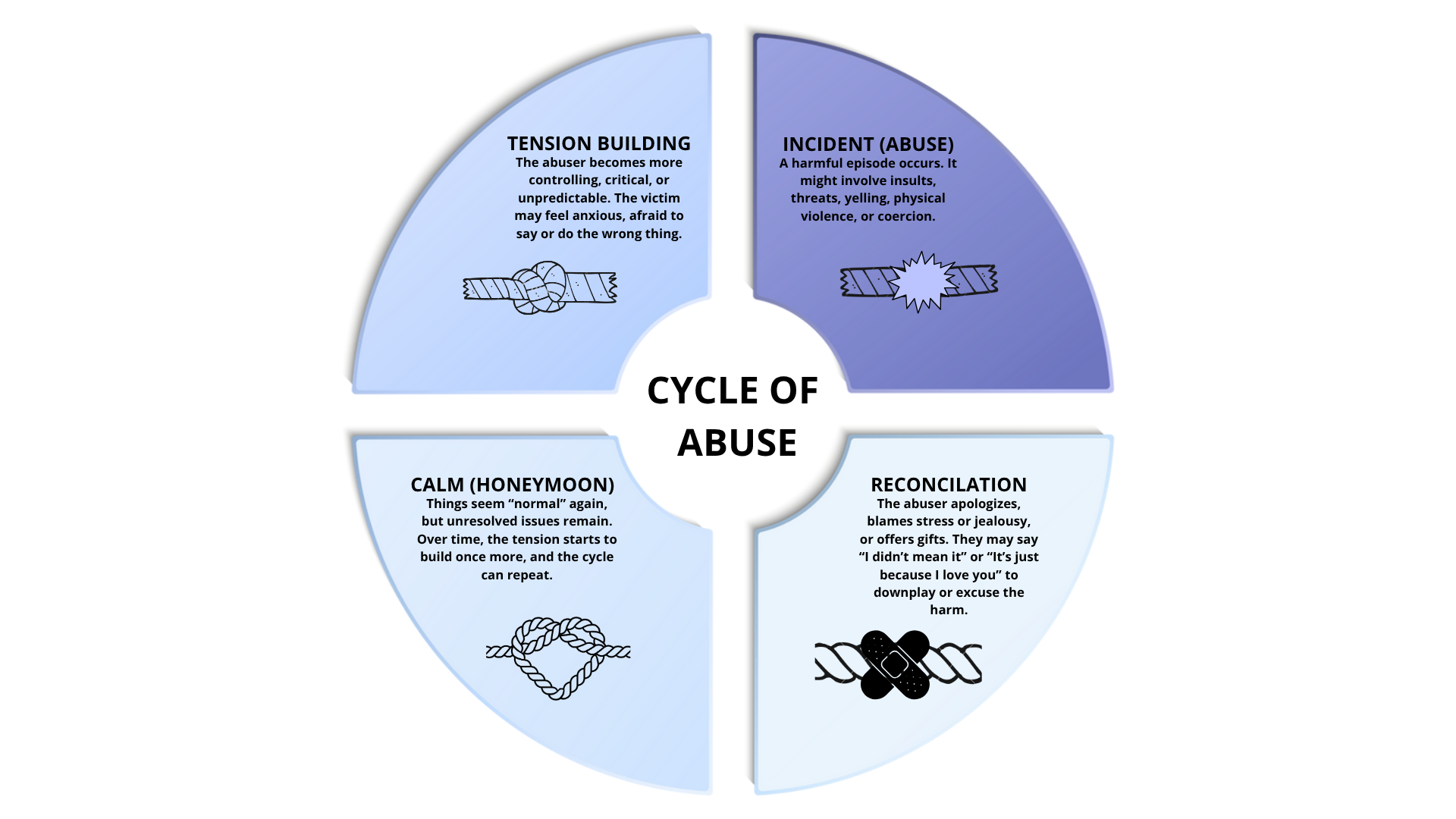
The abuser becomes more controlling, critical, or unpredictable. The victim may feel anxious, afraid to say or do the wrong thing.
A harmful episode occurs. It might involve insults, threats, yelling, physical violence, or coercion.
The abuser apologizes, blames stress or jealousy, or offers gifts. They may say “I didn’t mean it” or “It’s just because I love you” to downplay or excuse the harm.
Things seem “normal” again, but unresolved issues remain. Over time, the tension starts to build once more, and the cycle can repeat.
While some abusive relationships involve physical violence, many others rely on what researcher Evan Stark (2007) calls coercive control, defined as a strategic pattern of behaviours used to isolate, monitor, and dominate a partner. Stark explains that coercive control is not just about one act of harm, it’s about losing your freedom, slowly and silently. Over time, the person experiencing it may feel like they can’t make their own choices without fear. Even without physical violence, coercive control is a serious form of IPV that can severely affect mental health, self-esteem, and safety.
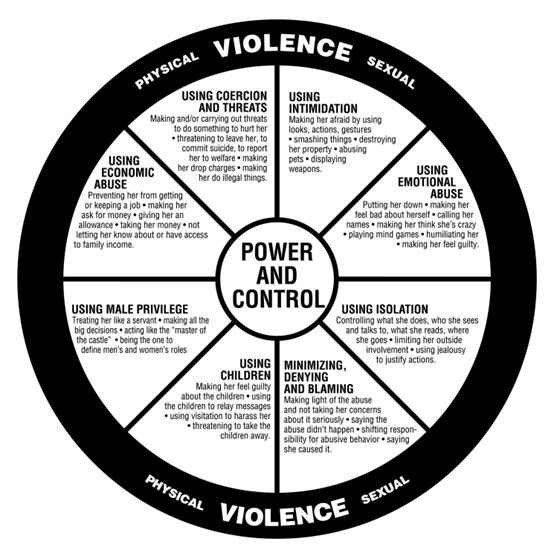
Developed by the Domestic Abuse Intervention Programs (n.d.) the Duluth Model: the Power and Control Wheel is a well-known tool used worldwide to explain the different tactics abusers may use to maintain control over their partners. It helps us understand that IPV is not just about anger or physical violence; it’s about using many forms of power to dominate and isolate someone over time.
The centre of the wheel shows the goal: power and control. The spokes show common abusive tactics, including: Using intimidation, emotional abuse, minimizing, denying, and blaming, using children, isolation, economic abuse, male privilege/gender norms, coercion and threats.
These behaviours often happen gradually and may seem small at first, but together they form a system of control that can trap someone in an unhealthy or dangerous relationship.
Many early red flags in a relationship don’t look like violence, and they’re often explained away as “passion” or “love.” This exercise presents you with common behaviours and asks you to decide whether they’re 🚩 warning signs, ✅ healthy behaviours, or ❓ depend on context.
1. They ask me to share my phone password.
Correct Answer: 🚩 Warning Sign
Explanation: Controlling behaviours like monitoring your phone can signal early-stage coercive control or surveillance, especially when framed as a sign of love or trust. Controlling behaviour is a pattern of behaviour that tries to control someone by scaring, isolating, or pressuring them.
2. They say they’re just trying to protect me from bad friends.
Correct Answer: 🚩 Warning Sign
Explanation: Abusers often isolate their partners by creating distrust toward friends or family, a common tactic to increase dependence and control.
3. They always check in when I get home to make sure I’m okay.
Correct Answer: ❓ Depends on Context
Explanation: Checking in can be caring in some relationships, but if it comes with pressure, surveillance, or anxiety when you’re not available, it can become controlling.
4. They tell me they can’t live without me.
Correct Answer: 🚩 Warning Sign
Explanation: Statements like this may seem romantic but can be emotionally manipulative, signalling dependency and potential for guilt-based control.
5. They encourage me to express myself, even when we disagree.
Correct Answer: ✅ Healthy Behaviour
Explanation: This reflects emotional safety and respect, key signs of a non-abusive, supportive relationship.
Some beliefs about relationships might seem romantic on the surface, but they can actually be quite harmful. One of the most widespread myths is the idea that jealousy is a sign of love, that being possessive, controlling, or overly watchful proves how much someone cares. But the truth is, when jealousy is mistaken for love, it becomes much easier to overlook early warning signs or normalise emotionally and psychologically abusive behaviours.
Research shows that people who strongly believe in romantic jealousy are less likely to recognise non-physical forms of intimate partner violence (IPV), such as emotional manipulation or coercion (Minto et al., 2022). Therefore, people may underestimate the seriousness of behaviours like isolation, monitoring, or guilt-tripping, especially when they interpret those actions as signs of affection. As a result, they might not seek support or realise the extent of the abuse until it escalates.
Jealousy also plays a role in manipulation. Some partners use it to control their significant others, making them feel ashamed, fearful, or emotionally dependent. Some women have reported feeling like they were being emotionally “puppeted” by their partners, who deliberately provoked jealousy or guilt to gain power over them (McCauley et al., 2023).
Control arising from jealousy may also show up through physical restrictions. Many women have reported experiencing coercive control related to their appearance, independence, and relationships with others (Moulding et al., 2021). For example, some were prevented from contacting their families or pressured to change how they looked, all under the justification of jealousy or mistrust.
In today’s digital world, jealousy often takes new forms, such as monitoring social media, reading messages, or demanding constant updates. Jealousy is found to be a key predictor of cyber dating abuse, a form of digital control and harassment in romantic relationships (Branson & March, 2021).
Understanding that jealousy is not love, and can, in fact, be a warning sign, is essential for recognising and resisting abusive dynamics early on.
Instructions: Users must select either the MYTH or TRUTH button. Once selected, a short explanation appear to reinforce the concept.
1. “Only physical violence counts as abuse.”
✅ Myth
Emotional and psychological abuse are also serious and damaging. They can be harder to see, but often happen early in abusive relationships.
2. “If it doesn’t leave a bruise, it’s not serious.”
✅ Myth
Abuse isn’t just physical. Threats, insults, and manipulation leave invisible scars that can affect self-esteem and mental health.
3. “Abuse only happens in low-income or uneducated communities.”
✅ Myth
IPV happens across all backgrounds, no one is immune based on money or education.
4. “LGBTIQA+ relationships don’t have the same abuse dynamics.”
✅ Myth
IPV also happens in LGBTIQA+ relationships, sometimes at even higher rates. Abuse is about control; it can occur across all genders.
5. “If they didn’t want to be hurt, they would just leave.”
✅ Myth
Leaving can be dangerous. Survivors often fear retaliation or don’t have safe options for support. Many survivors stay because they feel trapped, afraid, or emotionally attached. Some victims may be threatened or conditioned. It’s never as simple as just walking away.
6. “Most abuse happens later in life, after many years in a relationship.”
✅ Myth
Many women and men report that the abuse began early in the relationship, often before they turned 25 (World Health Organization, 2012).
7. “Many women who are murdered are killed by someone they loved.”
✅ Truth
Between 40% and 70% of women who are murdered worldwide are killed by intimate partners (World Health Organization, 2012).
8. “Men can’t be victims of IPV.”
✅ Myth
Anyone can be a victim of IPV. Almost 1 in 3 men report experiencing contact sexual violence, physical violence, and/or stalking by an intimate partner during their lifetime (Centers for Disease Control and Prevention (CDC), NISVS, 2024).
9. “Women rarely perpetrate IPV against men.”
✅ Myth
Among men who experienced rape, physical violence, or stalking by an intimate partner, 97% reported only female perpetrators (Centers for Disease Control and Prevention (CDC), NISVS, 2024).
10. “Jealousy is a sign of love.”
✅ Myth
Jealousy is often a warning sign, not a compliment. It can be used to excuse controlling and harmful behaviours.
🧷 Forms of abuse in dating and intimate relationships
Forms of abuse in dating and intimate relationships
Recognising different kinds of abusive behaviours from one intimate partner against the other that constitute dating violence/IPV. Identifying different types of dating violence/IPV: 1. Physical 2. Sexual 3. Psychological 4. Economic
Some people think abuse only means hitting or physical harm, but abuse in relationships can take many forms. Recognising these different forms can help people identify early warning signs and understand when a relationship is no longer safe or healthy.
Before continuing, please note: This content addresses sensitive topics and may bring up strong emotions. If you recognise yourself or someone you know in these examples, know that you’re not alone. Support is available, and reaching out for help is a strong and important step. You may find relevant assistance information in module 7 . If needed, take a break and return when you feel ready.
Types of Intimate Partner Violence (IPV)
- Physical Abuse: This type of abuse is defined as any act that causes physical harm as a result of unlawful physical force. Physical violence can take the form of, among others, serious and minor assault, deprivation of liberty, and femicide (EIGE, n.d.). Examples: hitting, slapping, pushing, choking, scratching, pulling hair, or throwing objects.
- Sexual Abuse: This type of abuse is defined as any sexual act performed on an individual without their freely given consent (EIGE, n.d.). Examples: unwanted touching, coercion, rape, sexual assault or pressure to perform sexual acts.
- Psychological (Emotional) Abuse: This type of abuse is defined as any act or behaviour which causes psychological harm to the partner, including coercion, defamation, verbal insult or harassment (EIGE, n.d.). Examples: threats, belittling, humiliation, intimidation, insults, isolation, ignoring, manipulation, guilt-tripping, controlling behaviours.
- Economic Abuse: This type of abuse is defined as acts or behaviour which cause economic harm to the partner, including control of access to economic resources, and refusal to comply with economic responsibilities (EIGE, n.d.). Examples: not letting someone work, taking their money, forcing them to depend on you financially, property damage, restricting education.
Instructions: Read each situation and drag the correct type of abuse.
1. “He grabbed my arm and pushed me against the wall during an argument.”
✅ Correct answer: Physical Abuse
o ✅ Physical Abuse
2. “They keep threatening to share private photos if I break up with them.”
✅ Correct answer: Sexual Abuse
o ✅ Sexual Abuse
3. “She checks my phone and tells me who I can or can’t talk to.”
✅ Correct answer: Psychological Abuse
o ✅ Psychological Abuse
4. “I’m not allowed to get a job or have my own bank account.”
✅ Correct answer: Economic Abuse
o ✅ Economic Abuse
5. “They insisted me to have sex even when I said I wasn’t in the mood.”
✅ Correct answer: Sexual Abuse
o ✅ Sexual Abuse
6. “He insults me in front of his friends and calls me ‘crazy’ when I get upset.”
✅ Correct answer: Psychological Abuse
o ✅ Psychological Abuse
7. “Every time we argue, she takes my debit card and hides it.”
✅ Correct answer: Economic Abuse
o ✅ Economic Abuse
8. “He cornered and pushed me when he got jealous because I talked to someone else.”
✅ Correct answer: Physical Abuse
o ✅ Physical Abuse
9. “They always want to know where I am, and get upset if I don’t reply quickly enough.”
✅ Correct answer: Psychological Abuse
o ✅ Psychological Abuse
10. “She makes me feel guilty for spending money on myself, even though I pay my share.”
✅ Correct answer: Economic Abuse
o ✅ Economic Abuse
🚦 Warning Signs & Green Flags: Spotting the Difference in Relationships
Some signs of unhealthy or abusive relationships can be easy to overlook, especially when they begin subtly or are disguised as concern or affection. It is essential to recognise the warning signs of an unhealthy relationship, but also to be able to distinguish between the green flags of a respectful, safe, and supportive one. This section helps you identify both warning signs of potential abuse and the green flags that indicate a healthy relationship. The content presented in this unit is based on the Youth4Youth booklet “Violence in Relationships: Myths and Realities,” developed by the Mediterranean Institute of Gender Studies (MIGS, 2012), supported by the European Commission.
Before you continue, please note: This section discusses sensitive issues. You or someone you know may recognise yourself in some of these situations. If so, know that you’re not alone. Take a break if needed, and remember there are support services available.
Controlling behaviours: telling you who you can talk to, what to wear, or how to act in public. This is often one of the earliest forms of coercive control and may escalate over time.
Isolation: Attempting to cut off your contact with friends, family, hobbies, experiences, or sources of support. Isolation is a hallmark tactic of coercive control.
Intimidation: Using threatening looks, gestures, or actions to instil fear or compliance. For example, threatening to leave the relationship unless their wishes are followed, or breaking objects, or yelling during conflict instead of resolving issues calmly.
Monitoring: Frequently checking your messages, location, or social media as a form of control rather than care.
Pressure: Insisting on sexual acts or decision-making before you’re ready or comfortable.
Gaslighting: Undermining your perception of reality, memory, or emotions to maintain power. For example, backhanded compliments, guilt-tripping “as a joke”, silent treatment, pretending to “joke” about breaking up, a partner making a person doubt their memory or reactions (gaslighting), minimising their concerns, or framing controlling behaviour as “just caring”
Jealousy as love: Claiming excessive jealousy is a sign of love and concern, this is a form of possessiveness, not affection. like a partner getting upset when you talk to someone else. Claiming that fighting a lot means passion or that being jealous is a love language.
Minimising or denying harm: Saying things like “you’re overreacting” or “that didn’t hurt” after an incident.
Recognising that a relationship is abusive, whether you’re the one being hurt or the one hurting someone else, can be really hard. That’s especially true when we’ve grown up with myths like “jealousy means love” or the idea that violence only happens if someone hits you. But abuse often starts in more subtle ways, like trying to control what someone does, who they talk to, or how they dress. These behaviours may seem small at first, but they can grow over time and have serious effects, especially emotional and mental health consequences (Minto et al., 2022; Kim et al., 2024).
In young relationships, things like wanting to “always be together” might feel romantic at first. But sometimes, they can actually be signs of control or possessiveness (MIGS, 2012). Abuse isn’t just something that happens to older people or in marriages. It can happen to anyone, at any age, in any type of relationship, including dating and situationships.
In fact, research shows that 10–16% of girls aged 18 to 24 in countries like Greece, Cyprus, Malta, Lithuania, and Latvia reported unwanted sexual experiences during a date, including attempted rape (MIGS, 2012). These are not rare cases; they reflect a wider problem that often goes unspoken.
Sadly, many people still believe harmful myths that blame the victim, saying things like “they were asking for it” because of how someone dressed or acted. But the truth is: no one ever asks to be hurt, and blaming the victim only protects the abuser (MIGS, 2012).
(Self-paced reflection activity)
💭 Have you ever seen or experienced any of these behaviours in relationships around you? How did it make you feel?
“I just worry about you” when used to justify checking your phone or controlling your friendships are a red flag, not affection.
“If you loved me, you would…,” or “If you don’t do this, I’ll leave you” are forms of emotional blackmail and coercive control.
One partner discouraging or limiting contact with friends/family, often subtly framed as “they’re a bad influence” or “they don’t understand our relationship”.
Constant texting for updates, insisting on sharing location, or asking for passwords under the guise of “trust” is emotional surveillance.
Calling a partner “too sensitive” or “crazy” when they express discomfort is gaslighting, a psychological abuse tactic.
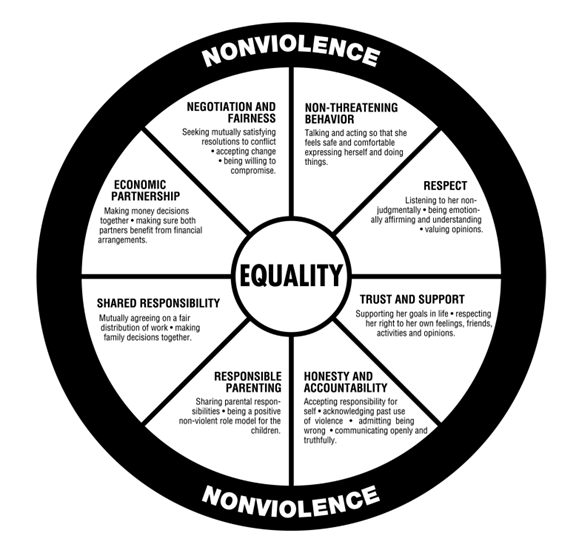
Green flags are the healthy opposite of red flags, they tell us when a relationship is respectful, safe, and based on equality. Some Green flags are stated below:
- Mutual respect and equality in decision-making, including respect for each other’s boundaries and individuality (e.g., where to go, who to hang out with).
- Comfort in self-expression: You don’t feel pressured to change who you are, in clothing, interests, or behaviour.
- Shared decision-making: From small choices like what movie to watch, to bigger decisions, both partners have a say.
- Healthy conflict resolution: Calm discussions without yelling or threats, and where both views are heard.
- Freedom to maintain friendships and independence: being able to “do your own thing” without guilt or punishment.
- Mutual respect for privacy and individuality: Each person supports the other’s interests, time with friends, and personal goals.
- Share information and spaces: Even though you don’t have to know everything about the other person, you can feel comfortable asking, and know the other person has the same freedom to share or not.
- Disagreements handled without fear: Disputes are approached calmly, with respect and without insults or retaliation.
- Comfort with emotional expression: Both partners feel safe saying when something is wrong or when they’re upset. feeling safe expressing thoughts, feelings, and needs. Such expressions are guided by trust and honesty, even when discussing difficult things.
Refer to the Duluth Model: Equality Wheel by Domestic Abuse Intervention Programs (n.d.). It shows the positive behaviours and values that are present in respectful, non-violent relationships.
(Self-paced reflection activity)
💭 Have you ever seen or experienced any of these behaviours in relationships around you? How did it make you feel?
“They remind me to take breaks and prioritise my mental health.”
“They respect when I need space and don’t make me feel guilty for it.”
“They ask for my opinion before making shared decisions.”
“They encourage me to keep in touch with friends and family.”
“They apologise when they’re wrong and change their behaviour.”
1. They text me 15 times if I don’t respond in 10 minutes.”
Answer: Red Flag
2. “They celebrate when I succeed, even when we’re going through something.”
Answer: Green Flag
3. “They get jealous when I hang out with friends and call it ‘normal’.”
Answer: Red Flag
4. “We can disagree without yelling.”
Answer: Green Flag
5. “They told me they understood where I was coming from and apologised when I said their comment hurt me.”
Answer: Green Flag
6. “He says I’m overreacting whenever I’m upset.”
Answer: Red Flag
7. “She always changes the subject when I want to talk about something serious.”
Answer: Red Flag
8. “She supports my relationships and encourages socialisation and spending time with friends.”
Answer: Green Flag
9. “They joke about breaking up with me when they’re annoyed, but never talk seriously.”
Answer: Red Flag
10. “When we disagree, we try to listen to each other, negotiate, give each other space, and try to arrive at a consensus.”
Answer: Green Flag
📚 References
- Barlow, C., Davies, P., & Ewin, R. (2023). ‘He hits me and that’s just how it is here’: responding to domestic abuse in rural communities. Journal of Gender-Based Violence, 7(3), 499–514. https://doi.org/10.1332/239868021X16535814891956
- Branson, M., & March, E. (2021). Dangerous dating in the digital age: Jealousy, hostility, narcissism, and psychopathy as predictors of Cyber Dating Abuse. Computers in Human Behavior, 119. https://doi.org/10.1016/j.chb.2021.106711
- Centers for Disease Control and Prevention (2024). Intimate partner violence, sexual violence, and stalking among men. Intimate Partner Violence Prevention. https://www.cdc.gov/intimate-partner-violence/about/intimate-partner-violence-sexual-violence-and-stalking-among-men.html
- Chan, B., & Sachs, C. J. (2023). Intimate Partner Violence and Sexual Violence. In Emergency Medicine Clinics of North America (Vol. 41, Issue 2, pp. 369–380). W.B. Saunders. https://doi.org/10.1016/j.emc.2023.01.007
- Connell, R. W., & Messerschmidt, J. W. (2005). Hegemonic Masculinity: Rethinking the concept. Gender & Society, 19(6), 829-859. https://doi.org/10.1177/0891243205278639
- Coston, B. M. (2021). Power and inequality: Intimate partner violence against bisexual and non-monosexual women in the United States. Journal of Interpersonal Violence, 36(1-2), 381–405. https://doi.org/10.1177/0886260517726415
- Council of Europe (2011). Convention on Preventing and Combating Violence against Women and Domestic Violence and its Explanatory Report.
- Eggers del Campo, I., & Steinert, J. I. (2022). The effect of female economic empowerment interventions on the risk of Intimate Partner Violence: A systematic review and meta-analysis. In Trauma, Violence, and Abuse (Vol. 23, Issue 3, pp. 810–826). SAGE Publications Ltd. https://doi.org/10.1177/1524838020976088
- European Institute for Gender Equality (n.d.). Forms of violence. https://eige.europa.eu/gender-based-violence/what-is-gender-based-violence/forms-of-violence
- Garcia-Moreno C, Jansen HA, Ellsberg M, Heise L, Watts CH. (2006). Prevalence of intimate partner violence: findings from the WHO multi-country study on women’s health and domestic violence. Lancet, 368(9543),1260-1269. DOI: 10.1016/S0140-6736(06)69523-8
- Greenman, S. J., & Matsuda, M. (2016). From early dating violence to adult intimate partner violence: Continuity and sources of resilience in adulthood. https://doi.org/10.1002/cbm
- Kwak, J., Taber, J., & Stults, C. B. (2024). Hegemonic masculinity, intersectional stigma, and intimate partner violence among young sexual minority men: A qualitative study. Psychology of Men & Masculinities. Advance online publication. https://dx.doi.org/10.1037/men0000513
- Kim, W., Cho, H., Hong, S., Nelson, A., & Allen, J. (2024). Concurrent Intimate Partner Violence: Survivors’ Health and Help-Seeking. Violence Against Women, 30(2), 503–523. https://doi.org/10.1177/10778012221132307
- Kumari, S. S., Kihara, A. B., Sohail, R., Majid, H., Gemzell-Danielsson, K., & Benagiano, G. (2025). Preventing gender-based violence: A global imperative. International Journal of Gynecology and Obstetrics. https://doi.org/10.1002/ijgo.70086
- Marcantonio, T. L., Jozkowski, K. N., & Williams, M. (2024). How do college students perceive their partner responds to them when they refuse sexual activity? Violence Against Women. https://doi.org/10.1177/10778012241232999
- Martin, S. L., McLean, J., Brooks, C., & Wood, K. (2019). “I’ve been silenced for so long”: Relational engagement and empowerment in a digital storytelling project with young women exposed to Dating Violence. International Journal of Qualitative Methods, 18. https://doi.org/10.1177/1609406919825932
- Mediterranean Institute of Gender Studies (MIGS). (2012). Violence in relationships: Myths and realities [Youth4Youth booklet]. Daphne III Programme, European Commission. https://www.medinstgenderstudies.org
- McCauley, H. L., Reid, T. A., Anderson, R. A. E., Ast, R., Zelazny, S., & Miller, E. (2023). Contextualizing cisgender women’s histories of Intimate Partner Violence victimization with men and women. Violence Against Women, 29(15–16), 3244–3262. https://doi.org/10.1177/10778012231199110
- Minto, K., Masser, B. M., & Louis, W. R. (2022). Identifying nonphysical Intimate Partner Violence in relationships: The role of beliefs and schemas. Journal of Interpersonal Violence, 37(5–6), 2416–2442. https://doi.org/10.1177/0886260520938505
- Muñoz, E. A., Le, V. D., Shorey, R. C., & Temple, J. R. (2023). Reproductive coercion and Intimate Partner Violence perpetration among young adult males. Violence Against Women, 29(14), 2775–2786. https://doi.org/10.1177/10778012231196059
- Moulding, N., Franzway, S., Wendt, S., Zufferey, C., & Chung, D. (2021). Rethinking women’s mental health after Intimate Partner Violence. Violence Against Women, 27(8), 1064–1090. https://doi.org/10.1177/1077801220921937
- Namatovu, F., Ineland, J., & Lövgren, V. (2024). Exploring the perspectives of professionals on providing Intimate Partner Violence services to women with disabilities. Violence Against Women, 30(2), 622–640. https://doi.org/10.1177/10778012221137916
- National Statistics Institute of Spain. (2023, November 24). Survey on domestic violence and gender-based violence (EVDVG) 2023 [Press release]. https://www.ine.es/dyngs/Prensa/en/EVDVG2023.htm
- Smith, S. G., Chen, J., Basile, K. C., Gilbert, L. K., Merrick, M. T., Patel, N., … Jaine, A. (2017). The national Intimate Partner and Sexual Violence survey 2010–2012 state report. Retrieved from https://www. cdc.gov/violenceprevention/pdf/NISVS-StateReportBook.pdf
- Stark, E. (2007). Coercive control: How men entrap women in personal life. Oxford University Press.
- Walker, L. E. (1979). The Battered Woman. Harper and Row.
- World Health Organization. (2022). Intimate partner violence. World Health Organization. https://apps.who.int/violence-info/intimate-partner-violence/
- World Health Organization. (2012). Understanding and addressing violence against women: Intimate partner violence. World Health Organization. https://apps.who.int/iris/handle/10665/77432