
Module 5: Consent and Healthy Relationships

Chapter Overview
Welcome to this module on Consent and Healthy Relationships. This path has been carefully designed for any person who wants to learn more about relationships. Whether you are exploring these topics for personal growth or to better support the young people in your community, you will find clear and comprehensive information and engaging tools to guide your journey.
Why is this module important for you?
Every individual deserves to experience relationships that are built on mutual respect, trust, and equality. However, in many societies, young people often grow up with mixed messages about relationships, love, gender roles, and power. Misunderstandings about consent and relational dynamics can lead to uncomfortable, harmful, or even dangerous experiences.
This module exists to equip you with the knowledge, language, and strategies to better understand what consent really means and how it plays a fundamental role in healthy intimate and social relationships. We’ll also work to identify behaviors that indicate respectful, caring relationships—and those that signal harmful or abusive patterns.
By engaging with the materials, reflections, and activities provided here, you’ll build your ability to communicate effectively, listen actively, and support both yourself and others in developing and maintaining positive relationships. We should remember that everyone expresses themselves, thinks, acts, and connects with others in different ways—so it’s essential to always make sure we have someone’s consent, understanding that it can be communicated through words, gestures, facial expressions, and other forms of non-verbal communication.
Consent is about communication, honesty, and respect. It’s not just about saying “yes” or “no,” but about ensuring all people involved are on the same page, feel comfortable, and have the ability to speak up or stop the interaction if needed.
Consent is a core element of healthy relationships. It helps build trust and mutual understanding, reinforces personal boundaries, and ensures that both people feel safe, valued, and respected. Without consent, there can be no true intimacy or connection, only imbalance and potential harm.
Chapter’s Learning Objectives
Upon completing this module, learners will be able to:
- Clearly define consent and understand how it applies to dating, intimacy, and everyday social interactions.
- Identify key features of healthy relationships, including mutual respect, trust, equality, communication, and boundaries.
- Understand the role of boundaries—how to set them, respect them,and promote a culture of gender equality and anti-violence
🧠 What is consent? Understanding your rights and responsibilities in relationships
Bear in mind that the main concept around consent is that consent is an ongoing process of discussing boundaries and what you’re comfortable with.
Consent is a clear and mutual agreement to engage in sexual activity. It means both people actively say “yes” and feel comfortable doing so. Consent should always be given freely, without pressure, manipulation, or fear. It’s not just about one moment—consent must be present every time, and it can be withdrawn at any point. Communicating openly with your partner about what you want or don’t want is essential. Asking for and giving consent helps set and respect personal boundaries. It also ensures that everyone feels safe and valued. Without consent, any sexual activity is considered assault. Checking in and staying honest are key to healthy intimacy.
Some characteristics of consent:
- Freely given. Consenting is a choice you make without pressure, manipulation, or under the influence of drugs or alcohol.
- Reversible. Anyone can change their mind about what they feel like doing, anytime. Even if you’ve done it before, and even if you’re both naked in bed.
- Informed. You can only consent to something if you have the full story. For example, if someone says they’ll use a condom and then they don’t, there isn’t full consent.
- Enthusiastic. When it comes to sex, you should only do stuff you WANT to do, not things that you feel you’re expected to do.
- Specific. Saying yes to one thing (like going to the bedroom to make out) doesn’t mean you’ve said yes to others (like having sex).
Consent is all about communication—and it matters every single time. Just because someone agrees to one thing once (like a kiss) doesn’t mean they’re okay with anything else, now or later. Each new situation needs its own clear “yes.”
It’s also totally okay to change your mind at any moment. If something feels uncomfortable, you have the right to stop—whether you say it out loud or show it through your actions or body language. That’s why it’s important to check in with each other and talk about boundaries. The best way to make sure everyone feels safe and respected is to keep communicating, ask questions, and always listen.
Sometimes, someone might take our behavior or response for granted and not ask for consent. It can also happen that someone ignores our answer and keeps insisting. Or a person might say “yes” without truly wanting to—agreeing to do something just out of politeness or guilt (for example, after accepting an initial intimate advance and not wanting to “disappoint” the other person).
You can say “yes” to any sexual approach through a gesture, and you can also say “no” with a gesture—both are just as valid as verbal consent or refusal.
So what happens if you say “yes” and then change your mind? Remember: consent can be withdrawn at any time, as soon as you no longer feel comfortable—even during the act itself. This applies to both long-term, established relationships and to casual or short-term ones.
Your will is what matters most, and it must always be respected.
Consent does not exist when:
- Someone says “no” and that’s ignored.
- A partner is unengaged, unresponsive, or visibly uncomfortable.
- You assume that flirting, certain clothes, or kissing means they want to do more.
- The person is below the legal age of consent in your country or region.
- The person is drunk, high, or otherwise unable to think clearly or give informed agreement.
- Someone feels pressured or scared into saying “yes” because of threats or intimidation.
- You assume it’s okay to do something just because it happened before.
Sometimes it’s clear who is doing something, but not clear who it’s for. That’s why it’s important to talk clearly, ask questions, and check that both people agree. Even simple questions like “Can we pause for a moment?” or “Can we try something different?” can help make sure everyone is comfortable.
- Benini, V. (2020). Senza tabù: Il mio corpo (come funziona), il piacere (come si fa). Fabbri Editori. https://www.violetabenini.it/senzatabu/
- Planned Parenthood of the Rocky Mountains. How do I talk about consent? https://www.plannedparenthood.org/planned-parenthood-rocky-mountains/learn/sexual-consent/how-do-i-talk-about-consentPlanned Parenthood
- RAINN. (n.d.). Understanding Consent. https://rainn.org/articles/what-is-consentGreenVibes.store
- Wheel of Consent. (n.d.). Wheel of Consent. https://www.artofconsent.co.uk/wheel-of-consent
💚 Healthy Connections: recognizing the foundations of respectful relationships
Relationships are a part of our everyday lives—whether with friends, family, romantic partners, or others around us. That’s why it’s important to understand how they work, which dynamics support our personal growth and well-being, and which ones may be harmful, unhealthy, or toxic. Relationships can take many different forms and are often shaped by cultural, social, and personal factors. Becoming aware of this complexity helps us recognize signs of problematic relationships, prevent uncomfortable or unwanted situations, and learn how to build safe, respectful, and healthy connections—essential for a balanced and fulfilling life.
Romantic relationships, in particular, are shaped by unique and personal ways of expressing affection and love. These types of relationships can also be influenced by power dynamics related to gender, age, social status, or health conditions. Have you ever wondered how these factors might affect your relationships? This section will help you recognize respectful and disrespectful behaviors, and how to maintain healthy and positive connections.
Being in a healthy relationship means feeling safe, free to express yourself, respecting your own needs and those of others, and knowing how to set and maintain personal boundaries. This comes from mutual trust, respect, honest communication, good listening, staying calm during conflict, and mutual consent.
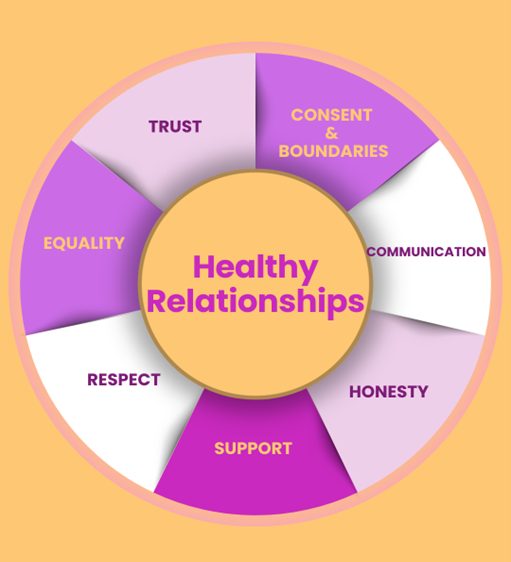
Examples of healthy and safe situations:
- There is consent: if you say “no,” your partner respects it.
- Your feelings and thoughts are heard and valued.
- You are treated with kindness.
- Your partner knows your circle of friends and family, because they are part of who you are.
- You have full control over your body: you decide how to dress, what to share, and what to keep private.
- Your personal boundaries are respected.
Adolescence is often when we start forming important relationships—with family, friends, teachers, and romantic or sexual partners. These experiences help shape how we understand care, trust, and respect. Sometimes, relationships grow naturally and feel easy. Other times, they can be confusing or even challenging. That’s why it’s important to understand what makes a relationship unhealthy and how to spot early warning signs. There’s no one way to start a relationship. Some begin in school, through shared activities, or online. What matters is that both people feel safe and free to be themselves. Starting something new can bring excitement, but also nervousness—especially around “first times,” like a first kiss or sexual experience. That’s totally normal.
Unhealthy relationships are ones where trust, equality, and respect are missing. Over time, these relationships can become harmful or abusive. This can include different types of behavior—like constant jealousy, emotional pressure, manipulation, or even physical violence. In more serious cases, it may lead to what is known as Intimate Partner Violence (IPV), Teen Dating Violence (TDV), or Domestic Violence—which means someone is being hurt or controlled in a romantic or family relationship.
It’s important to ask yourself:
- Why do I want to be with this person?
- Do I feel free to say how I really feel?
- Can I say “no” without feeling guilty?
- Am I being pressured to do things I don’t want to do?
- Do I still have time for friends, family, and myself?
If the answer to any of these feels uncomfortable, it might be time to reflect on the relationship.
What a Healthy Relationship Is Not
Here are a few signs a relationship may not be healthy:
- Your partner ignores or pressures you after you say “no”.
- You feel afraid to speak your mind.
- You’re being insulted, controlled, or isolated from your friends and family.
- You feel like you always have to please the other person.
- Your boundaries aren’t respected.
In a healthy relationship, you feel safe, supported, and free to be yourself—without fear, guilt, or pressure.
Gender-based violence is any form of harm directed at someone because of their gender or identity. While it can affect anyone, girls and young women are most often the victims. According to WHO, 1 in 3 women around the world has experienced gender-based violence (WHO, 2021).
One of the most common forms is violence from a partner or ex. Girls aged 15 to 19 are especially at risk—almost 1 in 4 who have been in a relationship has already experienced some form of abuse: physical, sexual, or emotional (WHO, 2021).
That’s why learning to recognize unhealthy behavior early on is so important. It helps protect your well-being, support others, and promote relationships based on respect, equality, and care.
Healthy relationships are empowering: they make you feel comfortable, respected, and free to explore who you are, including your sexuality—without pressure or fear. In a healthy relationship, you and your partner are equals, treating each other with fairness and care. Tell the other person what you would like, how you feel, what makes you happiest and what doesn’t make you feel best. Whatever your relationship is, you are important to yourself, that means your dreams, your interests, your ideas are important: make sure these are respected!
- Benini, V. (2020). Senza tabù: Il mio corpo (come funziona), il piacere (come si fa). Fabbri Editori. https://www.violetabenini.it/senzatabu/
- CESIE. (2023). LoveAct – Digital Guide: Living positive and intersectional sexuality education for gender-based violence prevention. CESIE. https://thegendertalk.eu/love-act-digital-guide/
- Pistes Solidaires. (2024). JERICHO Project Flyer. https://childrensafe.eu/media/jericho-flyer-en.pdfeu-for-children.europa.eu+2childrensafe.eu+2childrensafe.eu+2
- UNESCO, UNAIDS, UNFPA, WHO, & UN Women. (2021). The journey towards comprehensive sexuality education: Global status report. World Health Organization. https://unesdoc.unesco.org/ark:/48223/pf0000379607.locale=en
⚖️ Boundaries and balance: building equality and preventing gender-based violence
Gender equality is the concept that women and men, girls and boys and other genders have equal conditions, treatment and opportunities for realizing their full potential, human rights and dignity, and for contributing to (and benefitting from) economic, social, cultural and political development, and it plays a crucial role in shaping not only our society but also our closest, most personal relationships.
We can distinguish between the concepts of gender equality and gender equity, and it’s important to remember that they are not synonyms.
Gender equity refers to the understanding that women, men, and people of all genders may have different needs, experiences, and levels of access to power. To achieve fairness, these differences must be acknowledged and addressed. This can involve providing the same treatment to everyone, or offering different treatment that is considered equivalent in terms of rights, benefits, responsibilities, and opportunities.
In this unit, we explore how gender equality impacts romantic relationships, everyday dynamics between individuals, and the broader cultural and societal systems in which we live. We’ll use tools to understand the building blocks of equitable, non-violent relationships.
You may notice that some of the concepts we discuss in this unit—such as respect, communication, and consent—have already appeared in the previous modules. That’s not a coincidence. There is no such thing as a healthy relationship without mutual consent, and there is no real consent without healthy, respectful behaviour. These elements are interconnected: communication, trust, equality, and care are the foundation of a strong and safe bond.
Equality is composed of several key segments, each representing a healthy dynamic that promotes fairness and mutual respect. These include:
- Respect: Valuing each other’s opinions, listening, and supporting one another without judgment.
- Trust and support: Building each other up and respecting each other’s rights to their own feelings, friends, activities, and opinions.
- Honesty and accountability: Communicating openly and truthfully, admitting when you’re wrong, and taking responsibility for your actions.
- Responsible parenting: Sharing parenting responsibilities and making decisions together in a way that respects all family members.
- Shared responsibility: Making decisions together and recognizing both partners’ contributions.
- Economic partnership: Making financial decisions together and ensuring equal access to financial resources.
- Negotiation and fairness: Seeking mutually satisfying resolutions to conflict and accepting change.
- Non-threatening behaviour: Talking and acting so that each person feels safe and comfortable expressing themselves.
To understand how gender inequality shows up in relationships, we must also explore the cultural norms and power structures that shape how we behave. In many societies, historical and systemic inequalities have placed men in dominant roles, while women and gender-diverse people have been assigned submissive or secondary roles. These roles are often reinforced by media, education, religion, and law.
Stereotypes such as “men must be dominant” or “women must be caregivers” fuel imbalances that make it easier for inequality and even violence to arise. These beliefs influence how power is distributed in relationships and society—who gets to decide, who gets to speak, who gets to say no.
Power dynamics refer to the ways in which power is distributed and exercised in a relationship. This can involve physical strength, emotional manipulation, financial control, or social status. When one partner consistently holds power over another, it creates an imbalance that can lead to discomfort, coercion, and even abuse.
Romantic relationships should be spaces of mutual growth, care, and freedom. Unfortunately, they can also be spaces where gender norms and inequalities become more visible and harmful.
For example:
- If one partner controls all financial resources, that is not equality.
- If one partner makes all decisions without considering the other’s opinions, that is not fairness.
- If one partner expects the other to perform emotional or domestic labor without reciprocity, that reflects stereotyped roles, not partnership.
To achieve gender equality in relationships, we must actively challenge these patterns and build a shared understanding of roles, responsibilities, and rights. This includes:
- Making decisions together
- Dividing household tasks fairly
- Supporting each other’s goals and autonomy
- Respecting boundaries and consent
Economic inequality is a key driver of gender-based violence (GBV). When one person controls the financial resources, the other may feel trapped, unable to leave an unhealthy or dangerous situation.
This is why economic partnership—one of the segments in the Equality Wheel—is so crucial. Financial decisions should be made jointly, with transparency and respect. Each partner should have access to resources, decision-making power, and the ability to support their independence.
Many forms of GBV—such as emotional abuse, sexual coercion, or controlling behaviour—stem from power imbalances rooted in gender inequality. When a relationship lacks fairness, mutual respect, and communication, it becomes more vulnerable to violence. Visit and read carefully Module 2 on GBV to learn more about it!
Equality is not a destination, but an ongoing practice that we all have the power to shape.
- CESIE. (2023). LoveAct – Digital Guide: Living positive and intersectional sexuality education for gender-based violence prevention. CESIE. https://thegendertalk.eu/love-act-digital-guide/
- Domestic Abuse Intervention Programs. What is The Duluth Model? https://www.theduluthmodel.org/what-is-the-duluth-model/theduluthmodel.org+1theduluthmodel.org+1
- European Institute for Gender Equality. Gender Equality Training. https://eige.europa.eu/gender-mainstreaming/tools-methods/gender-equality-training
- European Institute for Gender Equality. (n.d.). Gender equity. EIGE. https://eige.europa.eu/thesaurus/terms/1175?lang=en
- Healthline. (n.d.). What does gender binary mean? Healthline. https://www.healthline.com/health/gender-binary#definition
Boundaries: an invisible line that defines what attitudes and behaviours are acceptable for an individual. Boundaries can be physical (e.g., “do not touch me”) or emotional (e.g. “do not lie to me”). Personal boundaries are simply the lines we draw for ourselves in terms of our level of comfort around others. For a healthy relationship, it is important for all involved to be able to draw their own boundaries, communicate them, and understand and respect those of others.
Sexual consent: consent means actively agreeing to be sexual with someone. Consent lets someone know that sex is wanted.
Consent: consent is the agreement to participate in an intimate or sexual activity – whatever it is: this means that before starting any practice with someone, you need to know if the person wants that too. Consent is the willingness of being together, it is the meeting point of common desires. It is a matter of personal boundaries, and respect of the boundaries of others; of knowing themselves and their desires, and being able to communicate them; of checking in if things aren’t clear; of responsibility, for asking it or giving it. To be consensual, sex must be agreed by all the people involved. Without consent, sexual activities is sexual assault or rape. However, if we stop and analyze the term, we will note that the word itself isn’t enough to help understand the complexity of what it means. For instance, while saying “yes”, a person could feel ashamed, fearful or lack the tools to say “no”: despite the fact that the person is explicitly and verbally consenting, the truth is the opposite.
Relationships: A relationship is a dynamic and multifaceted connection that exists between two or more individuals. Relationships could be between friends, colleagues, parents or caregivers, intimate partners, or others. They can range from casual acquaintanceships to deep emotional bonds, and they significantly impact our thoughts, feelings, actions, attitudes and behaviours, as well as other relationships.
Healthy relationships: those relationships which are communicative, respectful, trusting, and characterised by honesty and equality between/among partners, where boundaries are set and consent is practised.
Unhealthy relationships: We refer to unhealthy types of relationships that exhibit malaise and dysfunction that may not even be consciously recognized by the people involved. They may have a power imbalance (for example, there is no consent, mutual trust, compromise, or honesty). One or both people in the relationship may have trouble communicating and controlling their feelings. This could also include negative outcomes such as passive aggressiveness, manipulation, gaslighting, victim blaming, etc. in order to control the other people and use their power over them. Some unhealthy relationships could degenerate into physically, emotionally, psychologically or sexually violent relationships. We explore more details in our complementary video on this topic.
Romantic relationship: a relationship involving a deep, passionate love, which may include initial feelings of nervousness and excitement, and might develop into a long-term commitment. They may exist alongside a sexual relationship, and often involve a level of intimacy that is not present in other types of relationships.
Conflict: Disagreement or argument. Although conflicts can be unpleasant and painful, they are an inevitable part of any relationship, hence it is important to learn to deal with them calmly and effectively by employing techniques such as active listening and empathy, so that they are resolved as painlessly as possible.
Intimacy: Intimacy is the feeling of closeness and connection a person develops with special people in their life. Each relationship may involve different types of intimacy. Intimacy can be physical, intellectual, emotional, or even spiritual. It’s a feeling that many people develop with their closest loved ones. Some experts believe that, for romantic relationships to be successful, you may need to nourish all types of intimacy.
Violence: Violence are actions that physically, emotionally, psychologically or economically harms or controls another person. It can range from microaggressions to discrimination and stigma. Examples of violence can include hitting, verbal abuse, emotional manipulation or financial control.
Assertiveness: The act of being aware of our wishes, desires, rights, and openly and honestly standing up for them through a clear, positive communication (by behaviour, attitude, in speaking or in writing). It is the contrary strategy of a passive or aggressive approach: while passive people have weaker boundaries, easily oversteppable by others who can take advantage from them; aggressive people act with a low respect of others’ boundaries, often hurting them in the attempt to influence their behaviours.
Crush: Infatuation, emotional and romantic attraction towards someone.
Emotion: A conscious mental reaction (such as anger or fear) subjectively experienced as strong feeling usually directed toward a specific object and typically accompanied by physiological and behavioral changes in the body.
Gender-Based Violence (GBV): Gender-based violence refers to any type of harm that is perpetrated against a person or group of people because of their factual or perceived sex, gender, sexual orientation and/or gender identity. Gender-based violence is based on an imbalance of power. It is carried out with the intention to humiliate and make a person or group of people feel inferior and/ or subordinate. It can be sexual, physical, verbal, psychological (emotional), or socio-economic, among others. In this guide we understand gender-based violence both comprising violence against women and violence against all genders.
Abuse of power: A misuse of power by someone in a position of authority who can use the leverage they have to oppress persons in an inferior position or to induce them to commit a wrongful act.
Gender inequality: Legal, social and cultural situation in which sex and/or gender determine different rights and dignity for women and men, which are reflected in their unequal access to or enjoyment of rights, as well as the assumption of stereotyped social and cultural roles.
Intimate Partner Violence (IPV): A behavior by an intimate partner or ex-partner that causes physical, sexual or psychological harm, including physical aggression, sexual coercion, psychological abuse, and controlling behaviors.
Domestic Violence: All acts of physical, sexual, psychological or economic violence that occur within the family or domestic unit, irrespective of biological or legal family ties, or between former or current spouses or partners, whether or not the perpetrator shares or has shared the same residence as the victim.
Teen Dating Violence (TDV): Teen dating violence — also called intimate relationship violence or intimate partner violence among adolescents or adolescent relationship abuse — includes physical, psychological or sexual abuse; harassment; or stalking of any person ages 12 to 18 in the context of a past or present romantic or consensual relationship.
Stereotype: A false belief, often shared collectively, and internalized in the collective consciousness. Stereotypes are expressed by the exaggeration or extrapolation of several characteristics attributed to certain social groups. They are easily conveyed and established as general truths.
Intersectionality: It refers to the simultaneous forms of oppressions suffered by people in unseparate terms of ethinicity, gender, sexuality and class, among others by creating movements based on solidarity that work towards eradicating all overlapping forms of oppression. Intersectionality considers the complexity of identity as a process, ever-changing and nonhierarchical. Without an intersectional approach the risk is perpetrating epistemological violence by imposing one-sided values by “white women gender and “race” narratives from back men”.
- Benini, V. (2020). Senza tabù: Il mio corpo (come funziona), il piacere (come si fa). Fabbri Editori. https://www.violetabenini.it/senzatabu/
- CESIE. (2023). LoveAct – Digital Guide: Living positive and intersectional sexuality education for gender-based violence prevention. CESIE. https://thegendertalk.eu/love-act-digital-guide/
- CESIE. (2023). LoveAct – Educators’ Guide. CESIE. https://thegendertalk.eu/media/love-act-educators-guide-it.pdf
- CESIE. (2023). LoveAct – Activity Sheets. CESIE. https://thegendertalk.eu/media/annex-activity-sheets-it.pdf
- Council of Europe. What is gender-based violence? https://www.coe.int/en/web/gender-matters/what-is-gender-based-violence
- Crenshaw, K. (1991). Mapping the margins: Intersectionality, identity politics, and violence against women of color. Stanford Law Review, 43(6), 1241–1299. https://doi.org/10.2307/1229039
- Domestic Abuse Intervention Programs. What is The Duluth Model? https://www.theduluthmodel.org/what-is-the-duluth-model/theduluthmodel.org+1theduluthmodel.org+1
- European Institute for Gender Equality. Gender Equality Training. https://eige.europa.eu/gender-mainstreaming/tools-methods/gender-equality-training
- European Institute for Gender Equality. Gender equity. EIGE. https://eige.europa.eu/thesaurus/terms/1175?lang=en
- Healthline. What does gender binary mean? Healthline. https://www.healthline.com/health/gender-binary#definition
- National Institute of Justice. (n.d.). Teen dating violence. https://nij.ojp.gov/topics/crimes/teen-dating-violence
- Pistes Solidaires. (2024). JERICHO Project Flyer. https://childrensafe.eu/media/jericho-flyer-en.pdfeu-for-children.europa.eu+2childrensafe.eu+2childrensafe.eu+2
- Planned Parenthood of the Rocky Mountains. How do I talk about consent? https://www.plannedparenthood.org/planned-parenthood-rocky-mountains/learn/sexual-consent/how-do-i-talk-about-consentPlanned Parenthood
- RAINN. Understanding Consent. https://rainn.org/articles/what-is-consentGreenVibes.store
- UNESCO, UNAIDS, UNFPA, WHO, & UN Women. (2021). The journey towards comprehensive sexuality education: Global status report. World Health Organization. https://unesdoc.unesco.org/ark:/48223/pf0000379607.locale=en
- Wheel of Consent. Wheel of Consent. https://www.artofconsent.co.uk/wheel-of-consent
- World Health Organization. (2013). Responding to intimate partner violence and sexual violence against women: WHO clinical and policy guidelines. https://apps.who.int/iris/bitstream/handle/10665/77432/WHO_RHR_12.36_eng.pdf